Table of Contents
Wet Bulb Temperature
How ZENTRA Cloud calculates wet-bulb temperature from air temperature, humidity, and pressure, and how to create the model.
Table of Contents
Wet Bulb Temperature is the lowest temperature that evaporation of water into the air can cool a wet surface to. It combines air temperature and humidity in one value. In dry air it sits well below air temperature, because evaporation has a lot of room to cool. In saturated air it equals air temperature, because no further evaporation is possible.
ZENTRA Cloud also uses this value as one input to Wet Bulb Globe Temperature (WBGT).
Supported sensors
Wet Bulb Temperature can be calculated from one sensor that reports air temperature, humidity, and atmospheric pressure. All three inputs must come from the same sensor; a logger’s built-in barometer doesn’t count. These sensors qualify:
- ATMOS 41
- ATMOS 41W
- ATMOS 14
- VP-4
Create a WBT model
- On the Data page, select New Data.
- Select Wet Bulb Temperature as the type.
- Select one or more data sources from supported sensors.
- Edit the data color.
- Edit the data name.
- Select Create to finish.
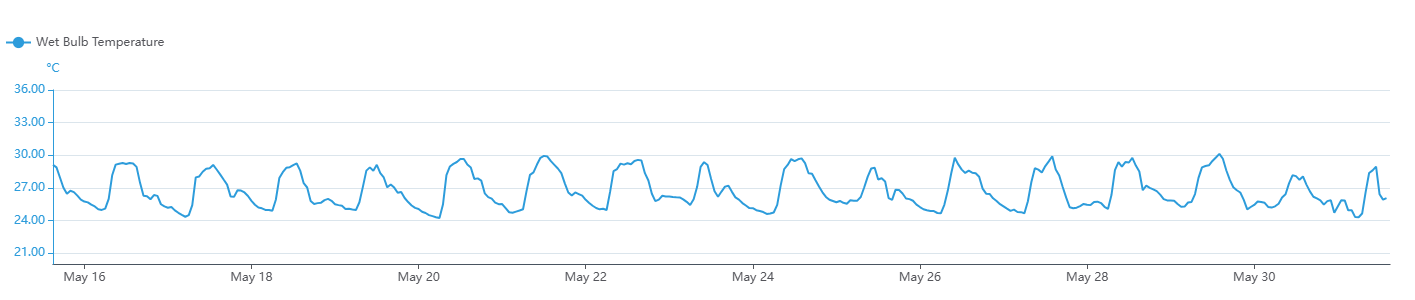
The new data will now appear in your data list. On charts, Wet Bulb Temperature shares the air-temperature axis, so the two can be read against each other directly.
How WBT is computed
ZENTRA Cloud calculates wet-bulb temperature for every reading that reports air temperature, humidity, and atmospheric pressure. It needs no wind speed, solar radiation, or device location.
- Humidity. ZENTRA uses the sensor’s vapor pressure, e, capped at the saturation vapor pressure es(Ta), where es(T) = 0.611·exp[17.502·T / (T + 240.97)] kPa and Ta is air temperature. This is the same as relative humidity capped at 100 %. ZENTRA uses saturation over liquid water at every temperature, including below 0 °C. Below freezing, values can therefore differ slightly from calculations that use saturation over ice.
- Wet-bulb temperature. Tw is the psychrometric wet-bulb temperature: the value that satisfies the equation below, where P is the sensor’s own atmospheric pressure in kPa. ZENTRA solves it by iteration.
e = es(Tw) − 0.000666·P·(Ta − Tw)This is the same calculation ZENTRA uses for the wet-bulb input to WBGT.
Psychrometric vs. natural wet bulb. The psychrometric wet bulb is the reading of a well-ventilated wet thermometer shaded from the sun. A WBGT meter uses a natural wet bulb instead: an exposed, unventilated wick. That wick reads higher than the psychrometric value, most of all in sun and light wind. If you compare ZENTRA’s Wet Bulb Temperature with the wet-bulb channel of a WBGT meter, expect ZENTRA’s value to be lower in those conditions.
When wet-bulb temperature is missing. A reading has a wet-bulb temperature only when air temperature, humidity, and pressure are all valid.
ZENTRA runs the calculation at the sensor’s full precision. Values are rounded to 0.1° only for display and export, in the organization’s chosen unit. Hourly and daily values are the average, minimum, and maximum of the per-reading value.
How did we do?